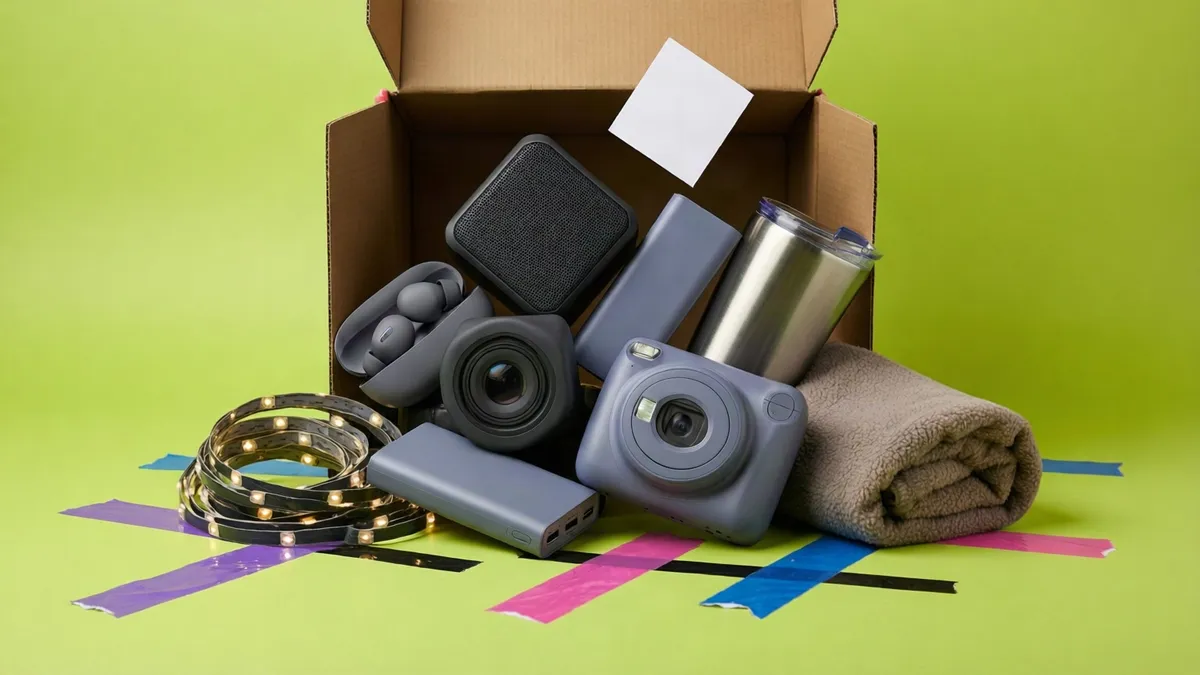
Short version: A trending gift earns its place only when it is the durable version of something your teenager already does every week. Sort every 2026 list by whether a pick compounds or expires. Then price it by age band: a lower amount for the 13-to-15 filler and a higher amount for the 16-to-19 main gift. If the only argument for a pick is that it is having a moment, buy the plain version of that category instead.
We write buying guides, not product reviews: we have not used every item on this page, and no teenager has graded it for us. Specifications come from the manufacturer or the listing, and whatever Amazon shows when you click is the authoritative figure.
This article contains affiliate links. If you buy through one, we earn a small commission at no extra cost to you. We only recommend what we would suggest to a friend.
The Federal Trade Commission's endorsement guides, 16 CFR Part 255, require a disclosure like that one to be difficult to miss, so it sits above every link here. Our full affiliate disclosure has the rest.
What we measured: We read the 13 ranking guides this search turns up in full (one more would not load) and compared what they recommend and price. Seven of the 13 list specific products with prices, and the same share push audio, power and body-care picks. Across those guides, quoted prices run roughly $11 to $100 with a median near $35 in our count. It could be wrong the obvious way: those prices are quoted in guides, not live listings, and all of it is a one-day snapshot.
Written by the editorial team behind this site — gift researchers who compile buying guides from public sources, manufacturer specs, and customer reviews rather than hands-on testing.
A trending list tells you what is being promoted this quarter. It does not tell you what your specific teenager will still be using in June. Our standing method, laid out in Gifts for Teens Without Guessing What's Trending, starts from the interest, not the moment. This piece applies it to the 2026 wave.
The Durable-Version Rule Cuts Every 2026 List in Half
Every entry on a trending list lands in one of two columns. Column one expires when the moment does: the scent, the colorway, the collectible. Column two compounds, because it feeds something the recipient already does at an age where the cheap version has stopped working.
The rule is simple. Use the trend list to find the category, never the product. Then ask one question of each candidate: does this get better or more useful the longer they own it?
A fad is not automatically a bad buy. A $15 version of a fad is a fine stocking-stuffer. The trouble starts when the fad is priced like the keeper, which is exactly how 2026 lists are built.
What Trending Gifts for Teens Actually Prove (Nothing, Yet)
Popularity on a list is a measure of visibility, not of want. Pew Research Center's 2024 survey of 1,391 U.S. teenagers found roughly six in ten ages 13 to 17 use the short-video app behind most of these trends. About as many open it daily.
Reach, in other words, is enormous. So is the advertising that rides on it.
The same Pew survey reported that one-third of teenagers use at least one of the five platforms it asked about almost constantly. That is the machine a trending list sits on top of. What you are seeing is what the feed repeated.
Run the home test before you buy anything:
- Name the interest they already have. If you cannot, stop and ask for a shortlist.
- Find the category on a 2026 list, then ignore its top pick.
- Check whether the recipient would use the plain version weekly.
- Compare the trending item's spec against the plain item's spec.
- Price both. If the trend premium buys color and not function, it expires.
- Buy the one you would re-gift without embarrassment.
Sorting the 2026 List: Fads, Keepers and the Overrated
Here is the sorting laid bare. The categories below recur on nearly every 2026 list; the verdicts are ours.
| Category | What puts it on the list | Expires or compounds?* | Buy instead* | Price band* |
|---|---|---|---|---|
| Wireless earbuds | New colorways, unboxing clips | Compounds, if the spec is right | Wireless earbuds with a stated battery rating | $25–$75 |
| Bluetooth speaker | Summer and party clips | Compounds | Rugged speaker with a listed run time | $25–$60 |
| Power bank, charger | Always-charging phone clips | Compounds | USB-C bank from an established brand | $20–$45 |
| Instant camera | Party photo clips | Compounds | Camera plus a film multi-pack | $70–$100 |
| Mini photo printer | Print-from-phone clips | Compounds | Printer plus a paper refill bundle | $50–$90 |
| Body-care set | Scent of the season | Expires | Fragrance-free cleanser and moisturizer | $15–$40 |
| LED strip light | Room makeover clips | Expires | LED strip lights with spare adhesive, or a smart bulb | $15–$35 |
| Tumbler, blanket hoodie | Carried-in-public trend | Split | Insulated tumbler; skip the hoodie for plain fleece | $15–$45 |
*Expires-or-compounds, substitutes and price bands are our editorial judgment, not sourced figures.
The wanted-gift data backs the second column. In the National Retail Federation's 2025 holiday survey, top gifts hoped for were gift cards (50%) and clothing or accessories (46%). Other popular items included books and media (27%), personal care (23%), and electronics (22%). Not a collectible in the bunch.
Our take: Our call is that audio, power and instant cameras are the only three categories where the trending version and the durable version can be the same purchase. Body-care sets and LED strips buy a moment, so cap them at stocking-stuffer money. If the budget only fits one real gift this year, spend it on the phone-adjacent pick. That is the object your teenager already touches a hundred times a day.
How Much to Spend on a Teenager, by Age Band
Trend lists never say the number, so here is ours. For 13 to 15, keep fillers under $25 and let the main gift sit at $50 to $100 if the occasion deserves one. For those in their late teens, skip fillers entirely and put the whole budget into the main gift.
The national numbers give you a ceiling, not a target. The National Retail Federation's 2025 holiday survey put average seasonal spending at $890.49 per person across gifts, food and decorations. Of that, $627.93 goes to gifts for family and friends. That includes everyone on the list, from coworkers to grandchildren.
Households with children planned to raise gift budgets by more than $30 on average, per the same NRF survey. Parents carry the big number. You do not have to.
Our suggested spend card, for anyone who is not the parent:
- Niece, nephew, godchild: one main gift at $50 to $100, or two fillers under $25.
- Cousin, family friend: one filler under $25.
- Group or cousin pool: one shared main gift at $50 to $100, split. Mid-band ideas that survive the rule are gathered in Gifts for Teens Under $50 for Cyber Monday. The food-inclined version lives in Cooking Gifts for Teens.
Audio and Power: Durability Is a Spec, Not a Moment
Trending earbuds are still earbuds. What separates a keeper from a fad is the listing, not the colorway. This includes stated battery life per charge, a replaceable or standard charging case, and a brand that will exist to honor a warranty. Buy on those three and the trend tag stops mattering.
Speakers follow the same logic. A run time in hours and a water-resistance rating are quoted per the manufacturer; anything that cannot state both is a tchotchke with a button. A Bluetooth speaker that survives a backyard summer compounds. One that cannot, expires.
Power is the quietest sure thing on any 2026 list, because the phone it feeds is nearly universal. Pew's 2024 numbers found 95% of U.S. teenagers ages 13 to 17 have or have access to a smartphone at home. Consequently, a USB-C power bank gets carried whether or not it is cool. Before you hand over any lithium battery, run the model through the U.S. Consumer Product Safety Commission's recall database.
One caution, not a scare: the American Academy of Pediatrics' media guidance recommends judging the quality of media use rather than counting minutes. Therefore, headphones are a neutral object. What they are used for is the parent's call, not yours.
Instant Cameras and Photo Printers: Where the Trend Is Real
This is the one category where the trending pick and the durable pick are the same object. The reason is scarcity. Pew's 2024 survey found 90% of U.S. teenagers ages 13 to 17 use the biggest video-sharing site, which means their photos mostly live on screens already. A physical print is the thing their feed cannot produce.
An instant camera only compounds if the film habit survives December. Buy the camera with a film multi-pack, not alone. A camera without film is a shelf ornament by February.
A mini photo printer is the better call for the 16-to-19 band, because it prints from the phone they already shoot with and skips a second device. Same rule applies: bundle the paper refills. The printer costs once; the paper costs forever, so gift the runway.
Body-Care Sets: Buy the Format, Not the Brand
The set on the 2026 lists is trending because of its scent, and scents are the fastest-expiring attribute in this whole guide. Pay for the brand and you are buying the moment. Pay for the format and you are buying the year.
The durable version is almost boring. A fragrance-free cleanser, a plain moisturizer, a real sunscreen. The listing states the ingredients; the brand's fame states nothing. Body-care gift sets at stocking-stuffer prices are fine as the small item, as long as they are not the main gift.
If you are shopping for a niece or a friend's daughter, the safer framing is skincare as a routine, not a look. That distinction, plus age-band splits, is worked through in Gifts for Teen Girls, Split by Age Band.
Last-Minute, Boys, and the Specific-Age Question
The same two-column test handles the edge cases, so scatter nothing. A 15-year-old sits at the top of the filler band: one under-$25 item plus a real gift if the occasion earns it. A 13-year-old is the age where the cheap version of their interest first stops working, which makes the durable upgrade land hardest there.
For boys, the trap is assuming the interest is not on the list. It usually is, just filed under audio, power or gaming accessories rather than trend objects. Gifts for Teen Boys That Are Not a Trend Object makes that case in full.
Last-minute is where fads win by default, so plan against it. The National Retail Federation's 2025 survey found 42% of shoppers start holiday browsing before November, which means the majority do not. If you are in that majority, a fast-shipping plain version of the category beats a trending item that arrives in January.
How much should I spend on a gift for a 15-year-old?
For a niece, nephew or family friend, half of what the parent spends is normal, which usually means one main gift or two fillers. If you want to go bigger, offer to split a $50-to-$100 main gift with another relative. That gets them the durable version without anyone overspending alone.
Should I just ask my teenager what they want, or keep the surprise?
Ask, but ask narrowly: request a three-item shortlist and pick from it. They get to be surprised by which one arrives, and you stop gambling on a trend they outgrew in October. Every experienced gifter thread on this question lands in the same place.
Are collectible character toys worth it, and are the ones in stock knockoffs?
The toy expires with the moment regardless of authenticity, so treat it as filler money only. If you buy one, order from the brand's own storefront listing and check seller history on marketplace offers, because unverified sellers are where knockoffs pool. Skip any listing with no brand name at all.
Is skincare or makeup a bad gift for a teenage girl?
Not if you skip the trending actives and stick to fragrance-free basics with a gift receipt included. If acne is the actual issue, a dermatologist visit beats any boxed set. Makeup is safer bought at a store with easy returns, since shade matching is personal.
What if my teenager has never heard of any of these trends?
Then the list was never about them, because trends run regional and algorithmic, not universal. Watch what they already carry, charge and wear out instead. The durable version of their existing habit works with or without the trend attached.
Devon Marsh writes buying guides, not reviews; nothing here was tested by us.
Sources
- National Retail Federation — "Consumers to Spend Second-Highest Amount on Record, According to NRF Holiday Survey" (https://nrf.com/media-center/press-releases/consumers-to-spend-second-highest-amount-on-record-according-to-nrf-holiday-survey) "Retrieved 2026-09-30".
- Pew Research Center — "Teens, Social Media and Technology 2024" (https://www.pewresearch.org/internet/2024/12/12/teens-social-media-and-technology-2024/) "Retrieved 2026-09-30".
- American Academy of Pediatrics — "Screen Time Guidelines" (https://www.aap.org/en/patient-care/media-and-children/center-of-excellence-on-social-media-and-youth-mental-health/qa-portal/qa-portal-library/qa-portal-library-questions/screen-time-guidelines/) "Retrieved 2026-09-30".
- U.S. Consumer Product Safety Commission (CPSC) — "Recalls & Product Safety Warnings" (https://www.cpsc.gov/Recalls) "Retrieved 2026-09-30".
- Federal Trade Commission — "Guides Concerning the Use of Endorsements and Testimonials in Advertising" (https://www.ftc.gov/legal-library/browse/federal-register-notices/guides-concerning-use-endorsements-testimonials-advertising) "Retrieved 2026-09-30".