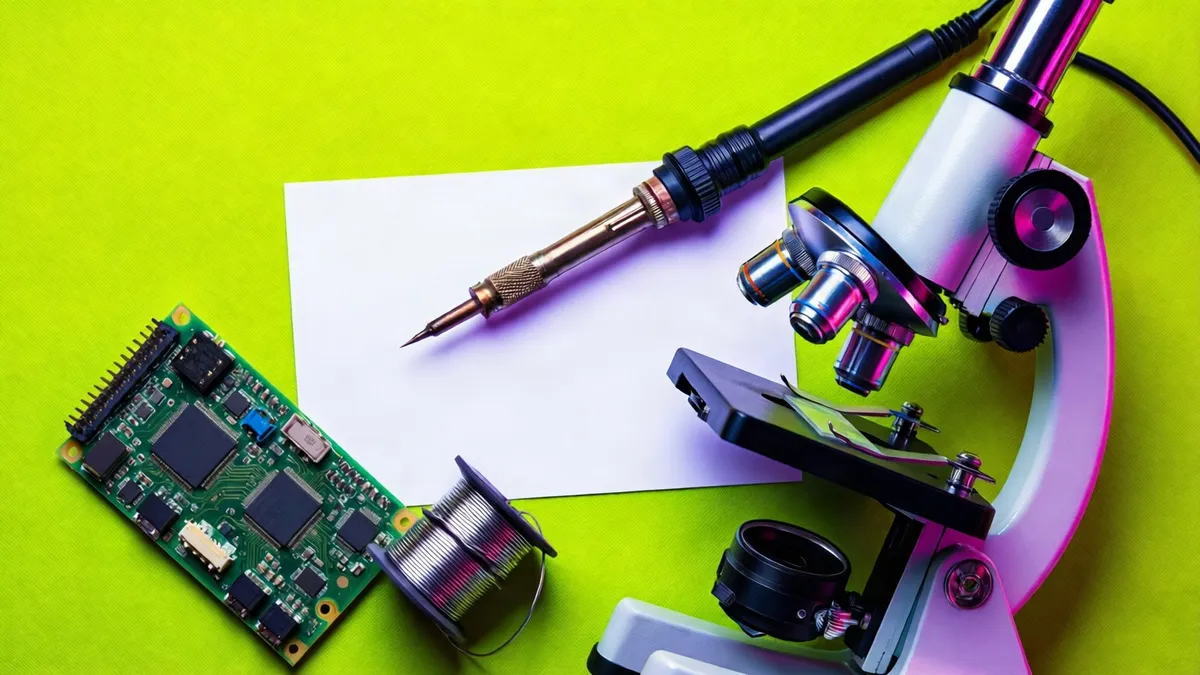
Short version: The STEM gift that builds a skill is the one a teenager can use without a lesson plan. A kit teaches one project and then dies. A tool — a soldering iron, a real microscope, a programmable single-board computer — gets used because it does something the teenager already wants to do. Buy the tool, not the kit, and you buy the skill.
We write buying guides, not product reviews: we have not used every item on this page, and no teenager has graded it for us. Specifications come from the manufacturer or the listing, and whatever Amazon shows when you click is the authoritative figure.
Most STEM gift lists are catalogs with a science coat on. In our comparison of 10 ranking guides on this topic, hands-on building toys appear on every single page and robotics kits on nine of ten. Almost none of them ask the only question that matters: what will the recipient still be using in month two? The same guides price their picks roughly between $20 and $150, with a median around $50, which tells you most of the market is selling kits. That is the shelf-clutter zone. This guide is the durable-version argument applied to one interest area, and it pairs with our pillar Gifts for Teens Without Guessing What's Trending.
Start With the Interest, Not the Category
Name the age band first. A 13-to-15-year-old usually needs the tool to be fun on day one, because patience for setup is thin. The 16-to-19 band will sit through configuration if the tool does something real, and they often already know which skill they want.
Then find the one true fact about how they spend an afternoon. Not "likes science." The specific thing: they game, they bake, they take apart broken headphones, they photograph the moon on their cell phone. A science book or a strategy game with real mechanics can feed a mild interest cheaply. But a kit bought against no interest at all is a $40 way to learn they don't care.
Our suggested checklist, in order:
- Name the age band: 13 to 15, or 16 to 19.
- Write down one thing they already do with their free time.
- Ask what tool a serious adult hobbyist in that thing would own.
- Check whether the tool works on day one without a lesson plan.
- Confirm it survives month two with a new project, not the same one.
- If no interest surfaces, buy a gift card and stop guessing.
For the Builder: A 3D Printer Beats a Marble Run
A marble run is a great afternoon. It is also one afternoon, then a box of parts that only reassembles one way. The same goes for one-shot brick construction sets: build it, display it, done.
The durable version of building is a machine that makes things. An entry-level 3D printer turns a file into a physical object, and per the manufacturer the better-known models print common plastics like PLA with minimal setup. The skill ceiling is what sells it: measuring, CAD sketching, slicing, troubleshooting a failed print. That is engineering with your hands, and it maps directly onto the kind of project work a STEM-minded teenager meets in school.
It is not the default pick, though. It needs desk space, it fails loudly, and a 13-to-15-year-old will need an adult nearby for the hot end. Buy it for a builder who already sketches objects and wants them real.
The Coder's Tool: A Raspberry Pi Beats a Robot Kit
A robot kit is a kit in the worst sense: assemble the chassis, run the app, follow the scripted moves, shelve the robot. The app-enabled gadgets have the same problem from the other direction. If the fun lives in someone else's app, the fun can be updated away.
A Raspberry Pi is the opposite. It is a full computer the size of a deck of cards, and the listing states the current models carry quad-core processors, real USB ports and Wi-Fi. That means the projects are limited by the teenager, not the box. Examples include a media server for the family TV, a retro game console, a camera trap for the backyard, or a first line of Python. One board, unlimited projects.
For a 13-to-15-year-old, buy it as a starter kit with the case and cables included so day one is a working computer, not a parts pile. The older band can handle the bare board and a separate power supply. This is also the pick for a teen who games and might want to know what is under the game.
The Scientist's Tool: A Real Microscope Beats a Crystal Kit
Grow the crystals, look at the crystals, done. A one-experiment kit is the purest form of shelf clutter, and the chemistry-in-a-box sets mostly follow the same arc.
The National Academies' report on successful K-12 STEM education makes the case against scripted science directly. Inquiry-driven work, where students ask the next question themselves, is what effective instruction looks like. A real microscope is inquiry in hardware. Pond water, onion skin, a scraped cheek, salt crystals they grew themselves last month. The slides never run out because the supply is the world.
A telescope earns the same argument at night, and both beat the kit version on cost per use. Check the listing for magnification and, on microscopes, whether it takes standard slides. Safety is mild here: glass optics and slides break, so a younger band member should carry it with two hands. For a first real microscope, the listing states most student models magnify up to around 400x to 1000x, which is plenty for pond life.
The Tinkerer's Tool: A Soldering Iron Beats a Circuit Kit
Snap-together circuit kits are honest fun, and they teach real logic. The ceiling is just low: the parts only connect one way, and the box defines the projects.
A soldering iron plus a breadboard is the open-ended version. The breadboard needs no heat and no license: a 13-to-15-year-old can wire an LED circuit in ten minutes and rewire it differently at dinner. The iron is the step up, and it is the tool that makes real repair possible. It fixes a broken headphone jack, a loose wire on a controller, or a first electronics project from a free tutorial. This is where problem-solving stops being a product feature and becomes a habit.
The iron is a 16-to-19 pick, or younger with an adult in the room, because the tip burns skin instantly and the fumes from flux need a window. A beginner soldering iron kit with adjustable temperature and a stand is the version to buy. Fun counts here too: the first project should be something they want, not a practice board they don't.
Three STEM Gifts for Teens That Outlast the Hype
Price bands below are ours, not a sourced figure, and they assume entry-level gear bought new. Skill ceiling and outgrow risk are our editorial judgment from how each tool is used.
| Tool | Price band (ours) | Skill ceiling (ours) | Outgrow risk (ours) |
|---|---|---|---|
| Single-board computer (Raspberry Pi) | $50 to $120 | Very high: full Linux computer | Lowest |
| Entry 3D printer | $200 to $400 | High: CAD, slicing, repair | Low, if space allows |
| Microscope or telescope | $40 to $150 | Moderate: observation and technique | Medium |
The long math favors all three. The National Science Foundation's statistics center reports the STEM workforce made up about a quarter of the total domestic workforce in 2023. Therefore, a tool that survives into college is not a toy budget line. And the pipeline keeps filling. The National Center for Science and Engineering Statistics reports enrollment in master's programs in science, engineering and health rose 22.1% between 2020 and 2024. For a teenager weighing a STEM major, a tool they have used for three years is a better answer than any kit.
Our take: Our call is the single-board computer for most buyers: cheapest entry, highest ceiling, and it doubles as a spare computer for the house. The 3D printer is the right gift only when the teenager already designs objects. They also need a place to put a machine that will jam, clog and print failures. For a teen who would rather observe than build, the microscope wins on price and the telescope wins on wonder; skip the kit version of either.
FAQ: The Edge Cases
What STEM gift works for a teenager who says they don't like science?
Stop shopping the science aisle. Match a tool to a hobby they already have. A gamer gets the single-board computer, a cook gets a cheap microscope for yeast and mold, and a builder gets the breadboard. An entry breadboard and component pack lands under $25, so the experiment is cheap for you too.
Are any of these safe to use without adult supervision?
The breadboard and the microscope are, for either age band: no heat, no serious voltage. The soldering iron is not, at least not at first. The tip runs hot enough to burn on contact, so treat it as a supervised tool until they have a dozen joints behind them.
Which of these works for siblings of different ages to share?
The microscope and the breadboard share well, because neither has an account, a save file or a queue. The 3D printer does not share well: one print queue, one frustrated sibling. If the age gap is four years or more, buy the shared tool and let the older one earn the printer later.
Do these tools come with warranties?
Usually yes, but the terms live with the manufacturer, not the gift guide. Reputable single-board computer makers and microscope brands typically back their hardware for a year or more, and Amazon's return window applies on top. Read the listing's warranty line before you buy; it varies by seller.
What is the best pick for a teen heading into a STEM major?
The single-board computer, because knowing your way around a Linux command line pays off in the first semester. The money argument is real too. The same federal statistics center reported in 2024 that 64% of science and engineering doctorate recipients had no education-related debt. Skills that earn tutoring or repair money in college are part of how that happens.
Which of these fits a classroom or afterschool program?
The U.S. Department of Education pushes exactly this kind of engagement through its YOU Belong in STEM initiative, and programs need tools that survive many hands. Breadboards and microscopes are the fit: no consumables, no licenses, no accounts to manage. One 3D printer can serve a whole group, but only with an adult who maintains it.
Devon Marsh writes buying guides, not reviews; nothing on this page was tested by us.
Sources
- National Center for Science and Engineering Statistics (NCSES) — "STEM Education | NCSES | NSF" (https://ncses.nsf.gov/interest-areas/stem) "Retrieved 2026-09-15".
- U.S. National Science Foundation, National Center for Science and Engineering Statistics — "STEM Talent: Education, Training, and Workforce" (https://ncses.nsf.gov/indicators) "Retrieved 2026-09-15".
- U.S. Department of Education — "YOU Belong in STEM" (https://www.ed.gov/about/initiatives/you-belong-stem) "Retrieved 2026-09-15".
- Federal Trade Commission — "Guides Concerning the Use of Endorsements and Testimonials in Advertising" (https://www.ftc.gov/legal-library/browse/federal-register-notices/guides-concerning-use-endorsements-testimonials-advertising) "Retrieved 2026-09-15".